

News

Reflections from a WCP researcher

Over the last few years, the WCP has been finding out about existing worker-climate activity - so we can learn what's working and what isn't. Now, in 2026, we're able to stand back and look at what we've learned - and share it with the movement. Our researcher Gina Moran shares their experience working on our Movement Assessment.
“I have found my research placement with the Worker-Climate Project incredibly rewarding. It has enabled me to develop my research skills, and ‘soft skills’ like time and project management, teamworking, and independence. Through this project, I’ve been able to be involved in a cause I feel passionately about.”
I completed a three month research placement with the Worker-Climate Project as part of the requirements for my PhD at the University of Leeds, which I am lucky to have funded by the White Rose Doctoral Training Program. My placement was a fantastic learning opportunity, during which I strengthened and developed my research skills - including research design, and secondary data collection, management, analysis and synthesis - as well as my more transferable skills - including time and project management, leadership and teamworking, resilience, independence, and adaptability.
During my placement, I focused largely on the WCP’s Movement Assessment project.
Movement Assessment and Skills Development
The Movement Assessment (MA) aims to identify and compile case studies of worker-climate action across the Worker-Climate movement in the UK, following on from many unionists, activists and others in the worker-climate movement asking the WCP whether a database of (successful) case studies existed. During my placement, I worked on various parts of the MA project, as part of a wider team from the WCP and the Movement Research Unit (MRU).
I co-designed the research methodology for the MA with WCP founder Toby MB. I found this process of bringing together mine and Toby’s academic and non-academic research styles and positions really interesting and enjoyable - I felt like our perspectives were great complements to one another! During this process, we went through a few different iterations of how we would adapt the academic thematic analysis research approach to suit the needs of this project. Thematic analysis is a way of analysing (typically written) data, by codifying bits of it that fit into different themes, or rather categorising them under different issues. For instance, the three key themes we chose for this project were networks (i.e. the people/workers/unions/organisations involved in worker-climate action), tactics (i.e. the strategies people/groups are using to achieve their objectives), and demands/goals (i.e. what people/groups are hoping to achieve through their climate-action). By pre-selecting themes in this way (in academic terms, creating a deductive thematic analysis framework), we made the analysis process much easier for anyone from any background - researcher or not - to follow. Given that the Movement Assessment Project brings together volunteer researchers from the WCP and the Movement Research Unit (MRU) who have a variety of levels of research experience and a variety of research backgrounds, this was crucial for the success of the project. In this way, the project made me much more considerate and pragmatic in my research design - who will be following this research design? How can I make it as clear and accessible as possible? How can I ensure the results generated are easy to map out and follow? - thus strengthening my research skills. This process also improved my science communication skills.
As an academic, I’ve found academics sometimes struggle to describe research processes and their research goals in lay terms without using a lot of jargon. In creating the Methodology Guide which the WCP now distributes to volunteers researching on the Movement Assessment project, I had to think carefully how to best communicate the how and the why of the method we were using, so others could easily follow it. I found this whole process not only strengthened my science communication skills (as well as my visual and written communication skills), but it also deepened my understanding of the research methods I often use during my PhD research.
Part of the project involved searching through the websites of all the TUC-affiliated unions, as well as those of other worker-climate and social justice focused organisations, searching for anything they’d written/published about worker-climate action. While this was quite a long process, I found it massively improved my secondary data collection skills. While I’ve collected secondary data before, I had not conducted a reasonably systematic collection of grey literature (i.e. non-academic literature). As time went on, I definitely became much more decisive and rigorous in determining which sources would be relevant and which wouldn’t be, as well as becoming much more familiar with the kinds of debates and positions present across the unions (and their economic sectors) and the organisations we were examining. Beyond data collection, the project also strengthened my data management skills. I co-created and managed the Airtable space for data storage and analysis, as well as creating and managing the shared space in the WCP Google Drive for longer analysis notes.
The majority of my time on the project was spent working independently and remotely, with a few full-team monthly meetings, check-ins with Toby, and the organisation strategy day in April. I found working independently really rewarding, and I was able to largely structure my hours to when they worked best for my work schedule. This project also hugely strengthened my flexibility and adaptability skills. While working independently and remotely worked incredibly well for me, and the rest of the team, it also meant that I would sometimes not be able to immediately get in contact with other members of the team for clarification. In these cases, I had to adapt my working patterns and what I was working on until I could chat with the other members of the team.
The project additionally improved my teamworking and leadership skills in a research environment. Although I’d worked in research teams before as part of research assistant roles I’ve held, the remote nature of this project definitely improved my ability to work as part of a team where we all have different (and sometimes limited) capacity, knowledge and skills. Moreover, during my placement I took on a leadership role in the team, communicating with other volunteer researchers who had come onboard the project, managing check-ins and running onboarding meetings.
What I think I enjoyed most about my placement with the Worker Climate Project was getting to see all the organising work that goes on behind the scenes in organisations like this, and getting to work alongside like-minded people organising towards a just transition. I think on the left we tend to think of organising work as demonstrating, protesting, and showing up in person. These actions matter and shouldn’t be overlooked. But, a lot of the hugely vital organising work that informs, sustains and helps grow our movements is the behind the scenes work of researching and networking work like the Movement Assessment. It has been truly inspiring and hope-inducing to see the work that the Worker Climate Project work on, and a real privilege to be a part of it. I can highly recommend volunteering with the Worker Climate Project - there are so many different ways to get involved!
Towards Instigation

Over the last 3 years, our work, such as our 2025 Trades Council Roundtables, has been focused on building greater connections between those currently involved in worker-climate efforts. By surveying and interviewing workers active in these struggles, we’ve been part of strengthening this movement’s understanding of its tactics and networks. However, as the climate movement itself has dissipated over the 2020’s, it has become increasingly more challenging for trade unionists to maintain a focus on the fight for a workers’ transition. This has led us as WCP to reflect on how our approach should develop alongside these conditions.
Now in 2026, we want to move towards supporting workers who want to begin taking transition action in their workplaces, industries and communities. Our previous work has positioned us well to facilitate workers who are just starting with such efforts to learn from the details of how previous tactics were used, analyse the specifics of their workplace conditions to consider what transition efforts could be won, and build contacts with those taking similar approaches in this movement.
Our move towards ‘instigation’ - that is, creating more worker climate activity - is primarily being made in two areas of work: our Movement Assessment and Instigation Events.
Movement Assessment
Over the last few months, we’ve begun work on our Movement Assessment (MA)- a huge resource aiming to build an accessible index of many worker-climate case studies, and build on this extensive overview of the movement to give our perspective on where we think its strengths and limitations have been in its development, and where the struggle could go from here.
In seeking to build a practical and thorough sign-posting resource - one that any trade unionist or activist can pick up and quickly find useful and inspiring case studies and campaigns - our MA builds upon the work of organisations such as the Greener Jobs Alliance and efforts within institutions like the TUC. With our indexing system, a viewer will be able to view every example, or filter for only those within their union or a particular tactical approach.
Drawing on this view of the movement so far, we will aim to offer some reflections as an organisation on which strategies are represented in the range of efforts we’ve found, where we think approaches could have been further developed, and what can be learnt for the fight going forward. We aim to follow these reflections up with events to facilitate strategic reflection among existing organisers, trade unions, and the left more broadly.
Instigation Events
We’ll start delivering Instigation Events. Drawing on our previous experience and MA work, we’ll be proactively going to trade union branches to support workers to look at the opportunities and challenges specific to their workplace and sector, learn about other workers’ efforts and think through which transition approaches would be most effective for them going forward. We aim to follow up these workshops with additional support, and develop a series of worker-climate 'surgeries', to share tips and build our strength together as we step up to take the action that is so needed for the good of workers and the planet.
From our conversations over the years, we’ve heard the same thing time and again from trade unionists: that climate is important, but it’s hard to make it a priority. Trade unionists are already fighting for their colleagues at work as well as taking action on an increasing number of urgent political and global issues. Luckily, our findings show that these don’t have to compete - climate can be a kind of lens through which other issues are seen, whether you’re campaigning for better health and safety or against the far right. Even so, it remains the fact that taking climate action requires some thought and effort. We hope that by making time to think through the possibilities of climate action together, and through sharing inspiring examples, we can support each other to build the worker climate movement we all urgently need.
To join us in these efforts, sign-up here
As the WCP, we begin our Trades Council Roundtables
Why Trades Councils?
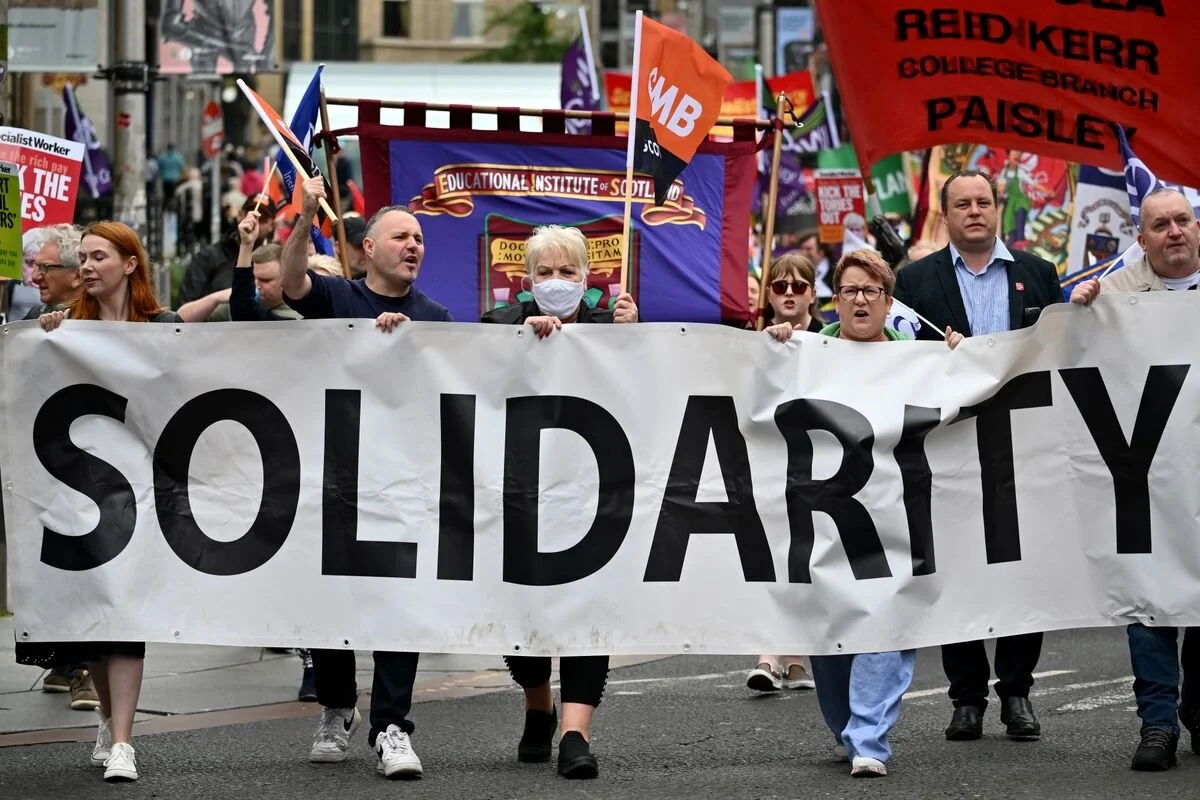
Trades Union Councils (often referred to as Trades Councils) are local groups of trade unionists who promote working-class solidarity in local communities. They are elected from trade union branches whose members live and/or work in the area. They promote effective solidarity in disputes, joint campaigns on issues such as health, education, welfare and transport. Many of these grassroots groups have historically been active on the issue of climate justice.
Many trades councils are contributing towards developing a just transition for their area, and others are keen to start this type of work. Our roundtables will help connect councils who’ve already made progress with others who want to learn more, helping energise a just transition in new locations and enabling cross-union collaboration.
First Phase
A series of three roundtable events will take place across February and March. At each event, three trades councils will present their work on climate justice to other local trade union activists and discuss learnings and challenges.
Here are examples of some exciting initiatives they will be sharing:
Collaborations with local climate groups on just transition and community wealth-building in Wakefield and Sheffield
Work on Climate Jobs in Blackpool which analyses how jobs could be created in green industries such as renewable energy, building retrofitting and public transport
Community solidarity campaigns such as Save St Fittick’s Park in Aberdeen which threatened access to green spaces for local communities due to a new port project and collaborations with Climate Camp Scotland
Organising events to explore climate justice and workers rights such as in Blackburn and Coventry
For the first phase, events are invite-only and we reached out to councils directly to invite them, but we will be sharing insights and follow up reports. Our first and second calls have taken place already, with the rest soon to come.
Next Phase
We are planning to then hold more workshops in the Spring to discuss the radical possibilities of worker-climate organising through trades councils.
We aim to collaboratively explore a method for trades councils looking at their local area and understand for examples
What industries are most at risk of closure due to action on climate change - for example, the oil and gas, automotive, and steel industries
What opportunities exist to create new sustainable sectors - for example, renewable energy, and retrofitting
What alliances can be created with local climate and community groups
Other factors affecting local workers and communities - for example, areas where there is no major industry but a huge need for sustainable jobs
We’re looking forward to working with this energised movement that cuts across trade unions, and seeing what emerges from their community action.
Help us to strengthen the struggle
If these exciting developments in our work make you want to help, we really need you as part of the team! We’re a small, volunteer organisation, so even a few more members is a massive boost to our ability to empower trade union structures such as trades councils in their struggle for a workers’ transition.
Go to our Get Involved page to join the team!
As the Worker-Climate Project rises, we say goodbye to LGND

There is no socialist strategy without a strategy for a worker-led transition away from fossil fuels. There is no socialist future without a worker-led green future. Let’s build the movement the world deserves.
Following substantial discussion on how a socialist climate politics can be developed in our current moment, LGND is coming to an end, with the Worker-Climate Project (WCP) continuing the campaign’s ambition in the workers’ movement. Read on for a look back at LGND’s history; more details about this decision; and how you can be involved in taking this politics forward with the WCP.
Nearly 6 years ago now, Labour for a Green New Deal (LGND) was founded, with the aim of developing a socialist climate politics both within Corbyn’s Labour Party and the British labour movement. In September 2019, LGND proved its effectiveness as an organisation by using the Labour Party conference to demonstrate that a huge mass of the British socialist movement was supportive of a transformative vision for our economy and society to address the climate crisis. Rather than an end in itself, this organising within Corbyn’s Labour Party played an important role in igniting a political current of socialist-climate thinking and policy, which undoubtedly influenced the ambitions of the 2019 Labour manifesto.
While this early success should be celebrated, it occurred in the context of a historical defeat for the British left –following a resounding electoral defeat and the victory of a hard-right Labour leadership. As an organisation, we were forced to begin the gradual work of building power in a political ebb. This meant an increasing focus on how workers were organising towards a transition in their workplaces, industries, and unions . We found many disparate, experimental efforts- with few clear successes to draw on. In this environment, the concept for the WCP was conceived to understand the forms of this embryonic movement, and to help build strong, strategic connections within it.
In early 2022, we formed the WCP, with our initial aim to organise a conference bringing together those most experienced in this struggle to share their methods, tactics and challenges. In the build-up to this October conference, we interviewed 24 activists to understand the depth of their approaches i.e. what union structures supported them, what networks they were part of, how they understood their methods and tactics –then produced sharable resources comparing these findings (which can be found on our website here). Outreaching for this conference also involved finding activists across the British labour movement, meaning we had a map of ~130 people with some details on their activities. The conference itself was a valuable space for tactical and strategic reflection from experienced and new organisers, and importantly produced the long-term feedback that a project of continuous networking would be our most valuable contribution.
Coming into 2023, this meant the WCP taking on the long-term work of creating team and administrative structures to be able to map and network this movement over a span of years. For a small team of volunteers, this meant taking an expansive view of the potential scale of our project, balancing between the limited capacity of our week-to-week work and preparing to be a growing project to be able to have the ambitious impact on this movement we saw it needing. Over the next two years, we conducted many more interviews; outreached further across sectors, regions and unions; and undertook deep consideration of the strategic interventions we could make alongside this work.
Alongside the development of the Worker Climate Project, LGND has continued to explore possibilities for interventions towards state power, even in the face of an explicitly hostile Labour leadership. In 2023, the Public Power Now project was launched to push the Labour Party to take a whole-system approach for energy nationalisation, from production to distribution and retail. While this pressure undoubtedly contributed to the announcement of their extremely limited ‘Great British Energy’ programme in 2022, LGND campaigners were increasingly finding left MP’s theoretically supportive but unwilling to break discipline. A new approach was needed; PPN was wound down and campaign members began to explore ideas for a project aimed at the level of local government.
Therefore, late 2024 found the work of LGND divided across two projects in very different phases of development; a very active and growing Worker Climate Project, and an embryonic Local Government Project. Discussions at a campaign wide general meeting about the changes to current political context in which we are organising since the campaign's formation in 2019 prompted reflections on the tensions arising between our aims for an ambitious socialist climate politics, and the current reactionary Labour party now in government. This led some key members of LGND to the conclusion that the most effective strategy for pushing for a radical, state-led response to climate change was now best achieved outside the existing structures of LGND. This divergence in the two key political projects previously united under LGND, supporting worker organising on one hand, and pushing for state power on the other, led to the difficult decision to end LGND as an overarching campaign.
So coming into 2025, this means the Worker-Climate Project building on its existing success, and the legacy of LGND, to reach even further in strengthening the fight for a worker-led transition. This means you’ll hear even more about our ongoing organising on our mailing list, with some updates from our sibling organisations coming out of LGND, as mentioned above. In the WCP, we will not only be expanding our ongoing efforts i.e. in-person and online outreach; in-depth interviews; comparative analysis and resource creation, but also beginning our first major intervention collaborating with a group of trades councils to help develop their just transition plans. This project will carry forward all the ambition outlined above, to explore how these cross-sectoral, cross-union structures can be used to coordinate climate struggles, and even lead on worker-led transition planning for their areas.
With these exciting developments, comes a pressing need. As we establish the WCP as its own organisation taking on many crucial political tasks, we need to grow our membership and support to make this happen. We are a small, volunteer team with a huge impact. So if you, or any comrades around you, are interested in getting involved in our work, you can massively add to our ability to be a transformative force. There are a huge range of skills, experiences, and types of organising needed to make this happen- to learn more check our information on getting involved here.